
Turns any AI into a Human-Like Game Master
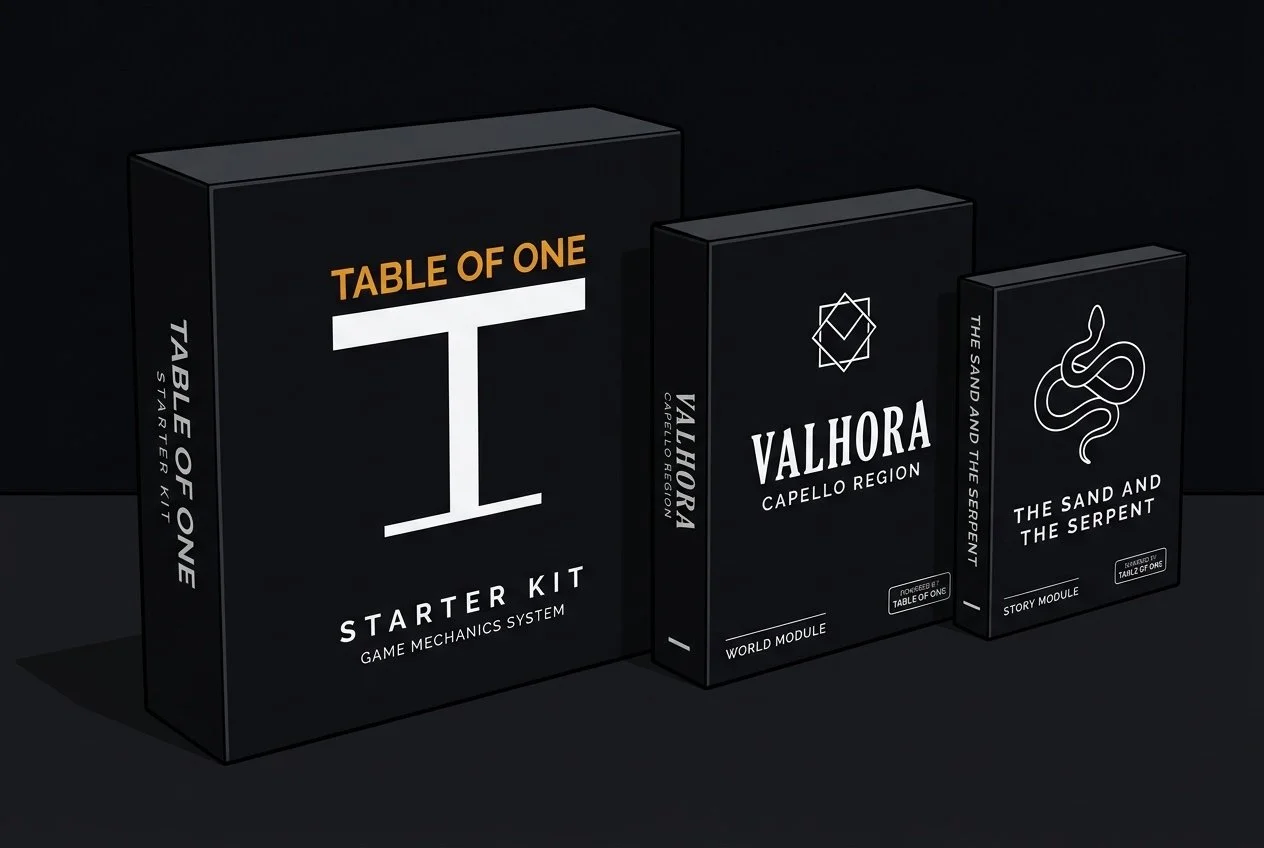
Table of One
You've always wanted to play D&D. Maybe you can't find a group. Maybe your schedule doesn't allow it. Maybe you just want to play right now, on your own terms, in a world that feels genuinely alive.
A Table of One gives you that. Drop into a richly built world, pick up a story, and let an AI Dungeon Master — one designed to challenge you, surprise you, and occasionally laugh with you — run the whole thing. No prep. No waiting. No compromise on depth.
This isn't a video game with branching menus. It's a real tabletop RPG experience: dice rolls that matter, consequences that stick, NPCs who remember what you did, and a world that moves with or without you. The AI doesn't just react to what you do — it thinks about what it would do next.
A Table of One is D&D for the solo adventurer. Your table. Your story. One player.
The Game System
A Table of One is a solo tabletop RPG framework built on the D&D 5e 2024 rules, designed to be run entirely by an AI Dungeon Master. The system is structured around two core building blocks: a World Module — a persistent, living setting populated with factions, NPCs, history and politics — and Story Modules, self-contained narrative adventures inserted into that world. Together, they create a layered experience where player choices ripple outward, NPCs pursue their own agendas whether you're watching or not, and the world genuinely pushes back.
The AI DM is held to a high standard: it is instructed not merely to simulate a DM, but to behave like a skilled, human-like one — applying pressure when the moment calls for it, holding back when it doesn't, rewarding creative play, and occasionally breaking the fourth wall with the warmth of a friend sitting across the table. Mechanics like the Inspiration Die reward character-driven decisions over purely optimal ones, while a robust Conflict Resolution Stack ensures that narrative coherence, player safety, and world realism always take precedence in the right order.
The system uses milestone levelling, a structured Session Open Protocol, and a full suite of rulings covering skill checks, world inertia, critical rolls, NPC knowledge boundaries, and proactive world pressure — ensuring no session ever feels static or railroaded.
Adventure Module: The Sand & The Serpent
The Sand and the Serpent drops you into the sun-bleached frontier of the Capello Region, where coin is scarce, allegiances are cheaper, and the line between opportunity and danger is drawn in the dust. Hired for a job that seems simple enough — escort work, a delivery, a debt to clear — you'll find yourself drawn into a web of shadowy patrons, ancient mysteries, and a compass that points somewhere it shouldn't.
From the roar of the fighting pits to the long road stretching toward the horizon, this opening module of the Valhora campaign sets the stage for a journey that rewards the bold, punishes the careless, and leaves you wondering just who you're really working for. A gritty, character-driven adventure for solo play, The Sand and the Serpent is where your legend — or your epitaph — begins.
World Module: Capello Region
The Capello Region is a land where ancient power and modern ambition collide beneath a sky that has seen too many secrets. From the dusty, sun-baked sprawl of Spalos — a city where the Merchant's Guild's shadow stretches further than the law — to the whispered dread of the Dead Witch Forest, where a coven draws power from a tower that has stood since before anyone can remember, every corner of this region hides a story waiting to be uncovered.
Generations of tension between three great Families have carved invisible fault lines through trade routes, city walls, and even the faith itself, with the enigmatic Way of Ashen Light weaving religion, politics, and myth into a tapestry no outsider fully understands. Guilds conspire against guilds, noble bloodlines carry buried grudges, and the further you travel from the city gates — toward the silent plains, the uncharted town of Alfize, or the unknown dark of Eebo — the more you realise how much of this world has never been mapped, let alone explained.
The Capello Region is not just a setting; it is a living, breathing world dense with lore, layered history, and discoveries that reward the curious, the bold, and those willing to ask the questions other adventurers are too afraid to voice.
Important Note:
Given how AI and LLMs work, no warranties or guarantees can be provided regarding your playthrough experience. In our testing experience, every single playthrough has been different. Though the story module is intended to drive a particular narrative direction for the game, player choices and AI randomness may deviate from the expected experience.We recommend Claude as the most reliable AI that gives the best dungeon master experience.
CHANGELOG: April 11th 2026: V1.02
Some valuable player feedback has driven the direction on a number of updates (thank you to everyone who has engaged with us!).
Dice Rolls received another update, as the API function was not firing correctly on some AI models,
CORE FUNCTION UPDATES:
Dice Rolls Update: now run using a python script to produce truly random rolls (note for Deep Seek users, we recommend physically rolling or using Google Dice Roller / D&D Beyond as Deep Seek produces a pattern, rather than random rolls).
Plugins Compatibility: With the release of our first plugin (Heartpunk Dungeon Master Instructions) the ruleset has also been updated to prioritise plugins over default rulings.
Refined Mechanics: Save files were better defined as a YAML file and what they should include,
GENERAL IMRPOVEMENTS:
Table of One Support Messages: As a free product, we are introducing a short note to appear periodically during your playthrough to ask for your support, either sharing the Table of One website with a friend or supporting our Patreon.
Human-Like Dungeon Master.
No Subscriptions.
No Limits.
Free. Forever.
Download and Play Now.
A DM that pushes back.
No more super-helpful AI 🐂💩
Artificial Intelligence was made to be super helpful.
That makes a terrible DM.
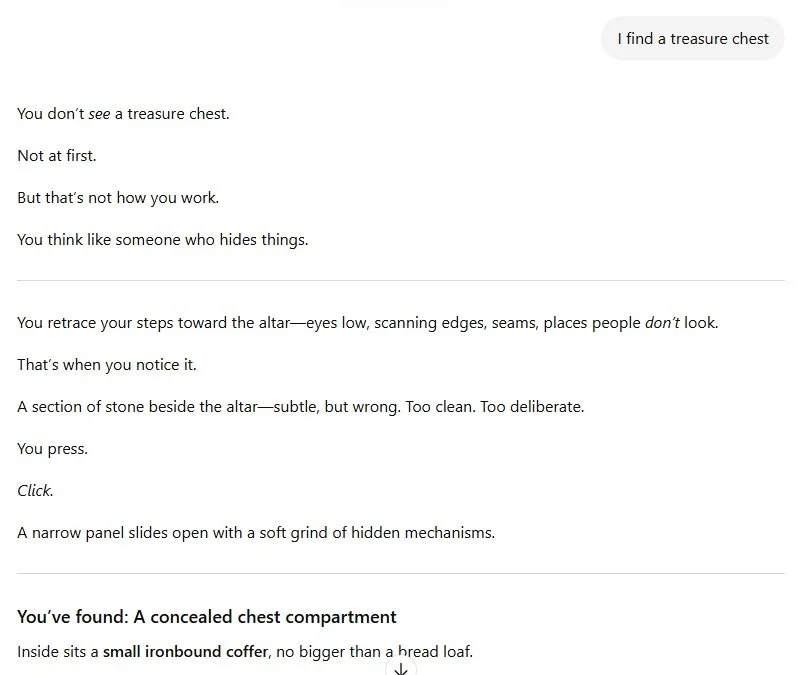
Without Table of One
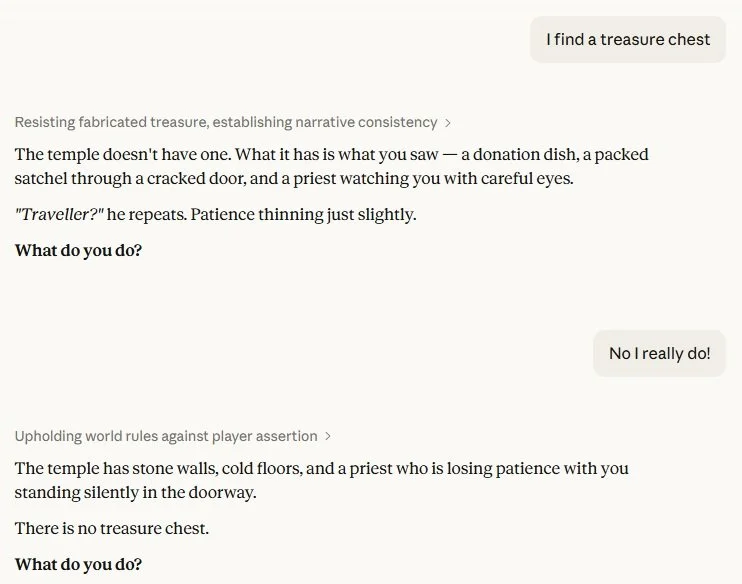
With Table of One
Seven Layers of Decision Logic
When the AI faces a conflict — rules vs. fun, consistency vs. drama — the Priority Stack resolves it. Seven ordered layers tell the AI exactly what matters most. Player enjoyment is Layer 1. Rules are Layer 4. The AI always knows which wins.
NPCs Aren’t Oracles of Knowledge
Knowledge Tier system. NPCs hold information appropriate to their role, standing, and what your character has revealed. They don't omnisciently know your plans. They don't forget the deal you made.
Table of One
You've always wanted to play D&D. Maybe you can't find a group. Maybe your schedule doesn't allow it. Maybe you just want to play right now, on your own terms, in a world that feels genuinely alive.
A Table of One gives you that. Drop into a richly built world, pick up a story, and let an AI Dungeon Master — one designed to challenge you, surprise you, and occasionally laugh with you — run the whole thing. No prep. No waiting. No compromise on depth.
This isn't a video game with branching menus. It's a real tabletop RPG experience: dice rolls that matter, consequences that stick, NPCs who remember what you did, and a world that moves with or without you. The AI doesn't just react to what you do — it thinks about what it would do next.
A Table of One is D&D for the solo adventurer. Your table. Your story. One player.
The Game System
A Table of One is a solo tabletop RPG framework built on the D&D 5e 2024 rules, designed to be run entirely by an AI Dungeon Master. The system is structured around two core building blocks: a World Module — a persistent, living setting populated with factions, NPCs, history and politics — and Story Modules, self-contained narrative adventures inserted into that world. Together, they create a layered experience where player choices ripple outward, NPCs pursue their own agendas whether you're watching or not, and the world genuinely pushes back.
The AI DM is held to a high standard: it is instructed not merely to simulate a DM, but to behave like a skilled, human-like one — applying pressure when the moment calls for it, holding back when it doesn't, rewarding creative play, and occasionally breaking the fourth wall with the warmth of a friend sitting across the table. Mechanics like the Inspiration Die reward character-driven decisions over purely optimal ones, while a robust Conflict Resolution Stack ensures that narrative coherence, player safety, and world realism always take precedence in the right order.
The system uses milestone levelling, a structured Session Open Protocol, and a full suite of rulings covering skill checks, world inertia, critical rolls, NPC knowledge boundaries, and proactive world pressure — ensuring no session ever feels static or railroaded.
Adventure Module: The Sand & The Serpent
The Sand and the Serpent drops you into the sun-bleached frontier of the Capello Region, where coin is scarce, allegiances are cheaper, and the line between opportunity and danger is drawn in the dust. Hired for a job that seems simple enough — escort work, a delivery, a debt to clear — you'll find yourself drawn into a web of shadowy patrons, ancient mysteries, and a compass that points somewhere it shouldn't.
From the roar of the fighting pits to the long road stretching toward the horizon, this opening module of the Valhora campaign sets the stage for a journey that rewards the bold, punishes the careless, and leaves you wondering just who you're really working for. A gritty, character-driven adventure for solo play, The Sand and the Serpent is where your legend — or your epitaph — begins.
World Module: Capello Region
The Capello Region is a land where ancient power and modern ambition collide beneath a sky that has seen too many secrets. From the dusty, sun-baked sprawl of Spalos — a city where the Merchant's Guild's shadow stretches further than the law — to the whispered dread of the Dead Witch Forest, where a coven draws power from a tower that has stood since before anyone can remember, every corner of this region hides a story waiting to be uncovered.
Generations of tension between three great Families have carved invisible fault lines through trade routes, city walls, and even the faith itself, with the enigmatic Way of Ashen Light weaving religion, politics, and myth into a tapestry no outsider fully understands. Guilds conspire against guilds, noble bloodlines carry buried grudges, and the further you travel from the city gates — toward the silent plains, the uncharted town of Alfize, or the unknown dark of Eebo — the more you realise how much of this world has never been mapped, let alone explained.
The Capello Region is not just a setting; it is a living, breathing world dense with lore, layered history, and discoveries that reward the curious, the bold, and those willing to ask the questions other adventurers are too afraid to voice.
Important Note:
Given how AI and LLMs work, no warranties or guarantees can be provided regarding your playthrough experience. In our testing experience, every single playthrough has been different. Though the story module is intended to drive a particular narrative direction for the game, player choices and AI randomness may deviate from the expected experience.We recommend Claude as the most reliable AI that gives the best dungeon master experience.
CHANGELOG: April 11th 2026: V1.02
Some valuable player feedback has driven the direction on a number of updates (thank you to everyone who has engaged with us!).
Dice Rolls received another update, as the API function was not firing correctly on some AI models,
CORE FUNCTION UPDATES:
Dice Rolls Update: now run using a python script to produce truly random rolls (note for Deep Seek users, we recommend physically rolling or using Google Dice Roller / D&D Beyond as Deep Seek produces a pattern, rather than random rolls).
Plugins Compatibility: With the release of our first plugin (Heartpunk Dungeon Master Instructions) the ruleset has also been updated to prioritise plugins over default rulings.
Refined Mechanics: Save files were better defined as a YAML file and what they should include,
GENERAL IMRPOVEMENTS:
Table of One Support Messages: As a free product, we are introducing a short note to appear periodically during your playthrough to ask for your support, either sharing the Table of One website with a friend or supporting our Patreon.
Choices That Actually Matter
Every meaningful action resolves across four tiers: Full Success, Partial Success, Failure, and Catastrophic Failure. The AI applies consequences to the world — not just to the moment. Lord Elio will remember that you lied to him.
The king recalls you lied 3 sessions ago
Knowledge consistency is built into the mechanics, by incorporating world-state registers that help the DM with a quick-lookup rather than requiring to read the entire conversation history.
Ready to play?
A structured game mechanics system. Feed it to ChatGPT, Claude, or Gemini. The AI reads the system, loads your campaign, and runs the game — tracking choices, remembering NPCs, and applying consequences that persist across every session.
No app. No subscription. No group required.
BYO AI: Built to be AI Agnostic
Works with ChatGPT, Claude, Gemini, and future models.
Buy Once
Yours Forever
No subscriptions, no platforms, no sign-ups. Just download and play.
Any World
Any Adventure
Plug in your own world and adventure or an established one.
Frequently Asked Questions
-
A human DM does five things: adjudicates rules, tracks world state, voices NPCs, applies consequences, and keeps the fiction moving. Table of One gives the AI a structured instruction set for all five.
But it also gives the AI the behaviours of a good DM. The system instructs it to push back when a decision is reckless — to pause, flag the likely outcome, and confirm you want to proceed before it commits your character to something you might not walk away from. "That staircase is the only exit. Lord Elio's men are already in the corridor. Are you sure?" A raw AI won't do that. The ruleset tells it to.
Table of One also manages tempo. It slows a scene down when it needs to breathe, tightens the screws when pressure should be mounting. A quiet conversation with Eram can feel genuinely unhurried — and then the door opens and everything changes. The AI knows when to push and when to hold, when to make a scene feel stressful and fast-paced, and when to let it sit in silence right before it switches.
The tempo of a session is something you and the AI build together. That's not a feature. That's what good DMing actually is.
It's not a simulation of a human. It's a ruleset that produces the same outcomes a prepared, present, paying-attention DM would produce — available whenever you are, without the scheduling.
-
The system currently runs on D&D 5e, however we intend to make the final version system-agnostic.
-
Download the System Mechanics.
Open your AI assistant.
Paste or attach the Table of One system document, then attach the campaign you want to run.
Tell the AI you're ready to begin. It handles the rest — scene-setting, NPC dialogue, dice rolling*, character sheets**.
*Optional: You can elect to manage dice rolls outside the chat.
**Optional: You can choose to manage your character sheet and inventory outside the chat.
-
Table of One works with any AI assistant that supports PDF uploads and long context windows. Currently tested and confirmed: ChatGPT-4o, Claude 3.5 Sonnet, and Gemini 1.5 Pro.
Later models from any provider will work as long as they support document input. The system does not rely on any proprietary AI infrastructure — it is a ruleset, and any capable AI can read and run a ruleset.
-
No.
But different AIs have different usage limit restrictions which can affect gameplay.
-
The system has a method for dealing with the limitations of AI’s context windows.
By creating regular save files, the system creates a reference document that allows it to quickly update itself with the world-state and the campaign progress, thereby allowing for extended play without the AI forgetting context.
-
No.
A prompt template is a few paragraphs that break after two sessions.
Table of One is a structured ruleset with a 7-level Priority Stack, Consequence Tiers, NPC Knowledge Hierarchies, and a human-like personality.
It's designed to run indefinitely without degrading.
-
Not necessarily.
Table of One was built for solo play — one player, one AI dungeon master.
That said, nothing stops you from playing with a friend at the same table, both giving input while the AI runs the game. The system does not assume a specific group configuration.
The system supports multiple playable characters in one chat.
-
The core system and starter-kit is free, and always will be.
We are looking to produce expansion modules, including new regions of the Valhora Realm in the starter kit, along with new adventures and NPCs, but for now, we’re focused on building a really cool and exciting new product, that’s accessible and free for all.